TL;DR
- Kitting and assembly are value-added fulfillment services that combine separate items: kitting bundles finished products under one new SKU while keeping them separable, and assembly permanently joins components into a single finished product.
- The right service depends on the problem: repeated multi-item bundles call for kitting, while products that must be physically joined or configured before sale call for assembly.
- In the warehouse, kits are built by picking each component, combining them at a kitting station, then labeling the finished kit with a new parent SKU and updating inventory records.
- Well-run kitting and assembly speeds up order fulfillment, cuts picking errors, raises average order value through curated bundles, and reduces the SKUs a business must hold in stock.
What Is Kitting?
Kitting in fulfillment is the process of grouping different products, or SKUs, into a single package that is stored, tracked, and sold under a new SKU. Promotional bundles containing multiple products and preconfigured subscription boxes are often kitted in advance so they are ready to ship when needed.
What Is Assembly?
In a warehouse, assembly is the process of joining two or more separate components into a single finished product that is then packaged, stored, and shipped. It sits between storage and manufacturing: the parts arrive already made, and warehouse staff put them together. It can include fitting parts together, fastening them, and checking the finished item before it goes out.
In 3PL logistics operations, light assembly may involve fitting region-specific power cords to electronics or mounting handles onto flat-packed furniture before dispatch.
Kitting vs. Assembly: What’s The Difference?
In fulfillment, kitting is often confused with assembly, but the two are distinct.
Kitting groups different products together to be sold as a single SKU.
For instance, when a bottle of wine is sold in a custom box alongside a complementary wine glass, the two items have been kitted into a promotional package.
Assembly joins separate components to create a single finished product.
In a warehouse, light assembly services can include, for example, attaching branded tags to luxury accessories, where staff loop small metal chains through leather designer labels and fasten them onto handbags or zippers.
How to Choose Between Kitting and Assembly Services
The right choice comes down to what problem needs solving. Kitting handles operational challenges around speed and handling, while assembly handles functional ones, where a product is not usable until its parts are joined.
When Kitting Is the Right Choice
Kitting fits when the same combination of finished products ships again and again, and when handling many separate items per order slows fulfillment down. It solves an operational problem rather than changing the product itself.
- Orders regularly bundle the same set of SKUs, such as subscription boxes, gift sets, or promotional bundles.
- Multi-item picks are pushing up labor time and mis-pack rates, especially during peak season.
- A bundle needs to reach the market quickly, built from stock already on hand.
When Assembly Is the Right Choice
Assembly fits when a product cannot be sold until its parts are physically joined or configured, or when units need finishing for a specific market once demand is known. It solves a functional problem, because the item is incomplete until the work is done.
- Components must be fitted, fastened, or installed before the product works, such as flat-packed furniture or region-specific electronics.
- Generic units need late-stage customization, like the correct power cord, plug, or manual for a destination market.
- The finished item needs a quality check for correct construction before it ships.
The Kitting Process in the Warehouse
The core kitting process in a warehouse follows these stages:
1. Order Creation & SKU Mapping
The Warehouse Management System (WMS) records the kitting job and links multiple independent item SKUs together under a single “Parent SKU”.
2. Bulk Picking
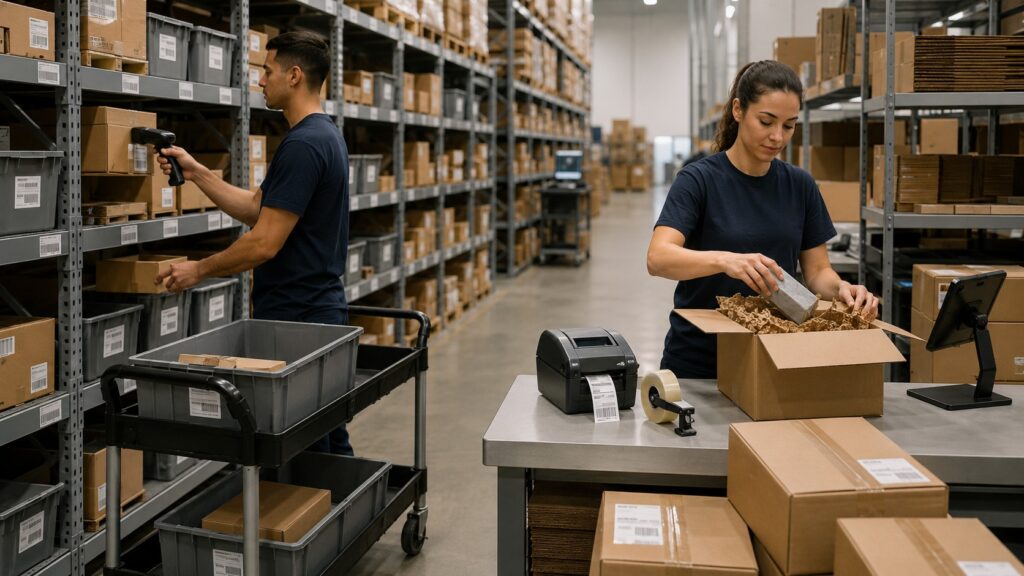
Warehouse staff pick the required quantities of each individual item from their designated storage locations and bring them to a dedicated kitting station.
3. Kit Building
At the kitting station, warehouse staff build each kit. This involves placing the items into custom promotional packaging, adding marketing inserts such as coupons or stickers, and sealing the final box.
4. SKU Labeling & Inventory Update
New barcode labels are applied to the outside of the finished kit. The WMS automatically updates inventory by deducting the quantities of individual components and adding the completed kits under the new SKU.
5. Staging or Direct Shipping
Once completed, kits generally follow one of two fulfillment paths:
- Pre-kitting: Completed kits are stored as finished inventory, ready to be picked and shipped as soon as an order is placed.
- Just-In-Time (JIT) Kitting: The kits are built on demand as orders arrive and then sent directly to the shipping area.
Benefits of Warehouse Kitting
In e-commerce fulfillment, value-added services – including custom kitting, labeling, assembly, and specialized packaging – are projected to grow at a 10.15% compound annual rate through 2031.
And for good reason.
Building kitting and assembly into a fulfillment operation delivers advantages across warehouse operations and sellers alike.
Simplified Picking and Fewer Errors
For outbound fulfillment, picking one completed kit SKU instead of several component SKUs can simplify order processing and reduce picking errors.
Faster Peak-Season Throughput
Kits built during quieter weeks are ready to pick as single units when volume spikes, so order processing speed holds steady without proportional increases in seasonal headcount.
Increased Revenue
For sellers, kitting is a powerful tool for boosting Average Order Value (AOV) by encouraging customers to purchase curated sets or promotional bundles.
Faster Promotional Turnaround
Seasonal bundles, influencer sets, and limited editions can be built from existing stock in days, letting sellers act on demand signals without commissioning additional manufacturing runs.
Benefits of Warehouse Assembly Services
Light assembly services add further value to warehouse operations in several ways:
Late-Stage Market Customization
Generic units can be finished for a specific market once demand is known – fitting the required power cord, manual, or plug – instead of committing to market-specific configurations during manufacturing.
Fewer SKUs to Hold
One base unit finished on demand can replace several market-specific variants in stock, freeing capital and reducing the risk of obsolete inventory in slower regions.
Lower Inbound Freight Costs
Components shipped flat or unassembled use container space far more efficiently than bulkier, and often uneven, finished goods, reducing the per-unit cost of inbound freight.
Examples of Kitting and Assembly
Kitting is already common in fulfillment operations, with approx. one-third of warehouses offering it as a value-added service. Common kitting and assembly applications include:
- Subscription Boxes: Curating various items into a single branded box for monthly delivery.
- Electronics Bundles: Packing a laptop with its compatible charger, mouse, and external keyboard.
- Manufacturing Support: Preparing hardware sets, such as grouping screws and washers needed for a furniture assembly step in a single organized package for the buyer.
- Apparel Customization: Using heat presses to attach branded patches to blank T-shirts before shipping.
- Point-of-Purchase (POP) Displays: Assembling cardboard retail displays from flat-packed pieces.
Looking for a Better, More Scalable Way to Handle Kitting and Assembly? Contact ACT Fulfillment today.
Kitting & Assembly FAQs
When should you outsource kitting to a 3PL provider?
Outsourcing the kitting process to a 3PL is often the best option when order volumes grow beyond your current labor capacity, when warehouse space becomes limited, or when you need specialized expertise to scale complex kitting operations.
What is kitting in manufacturing?
In manufacturing, kitting is an internal logistics process where all the parts, materials, tools, and instructions needed for a specific production task are pre-sorted and delivered to the assembly line as a single, organized unit to speed up production.
What is the difference between kitting and assembly?
Kitting groups separate finished products, each with its own SKU, into a single package sold under one new SKU. The items stay distinct and could be separated again. Assembly joins raw parts or components into one finished product that did not exist before, permanently combining them into a new sellable item. The practical split is reversibility and effort: kitting is lighter packing work that stays reversible, while assembly physically transforms parts and usually needs more skill, tools, and a quality check.
What is kitting and assembly?
Kitting and assembly are value-added fulfillment services that combine separate items into one unit before shipping. Kitting gathers multiple products into a single package tracked under a new parent SKU, such as a subscription box or promotional bundle. Assembly joins individual components into a finished product, like fitting a power cord to an electronic device or mounting handles on flat-packed furniture. Third-party logistics providers commonly offer both to speed up order fulfillment, cut handling, and prepare products for sale.
Who provides kitting and assembly services?
Third-party logistics (3PL) providers and fulfillment warehouses are the main providers of kitting and assembly services, usually offering them as value-added services alongside storage, pick and pack, and shipping. Outsourcing to a 3PL gives brands access to dedicated kitting stations, warehouse management systems, and trained staff without building the capability in-house. This is a common choice for ecommerce and retail businesses that need bundles, subscription boxes, or light assembly handled at scale, particularly when order volumes rise or peak seasons strain internal capacity.
What is the difference between kitting and pick and pack?
Pick and pack selects existing individual products from storage and packs them for a specific order as it comes in. Kitting happens earlier: multiple products are combined into one prepared unit under a new SKU before any order arrives, so the picker later handles a single kit instead of several separate items. In short, pick and pack fulfills orders from loose stock, while kitting builds the bundle first. Many operations use both, kitting the bundles in advance and then picking and packing them like any other SKU.
Does kitting reduce shipping costs?
Kitting can lower shipping costs by consolidating several items into one package, which means fewer parcels, less dimensional weight from empty space, and simpler carrier handoffs. Because a kit ships as a single unit under one SKU, it also cuts the picking and packing labor tied to each order. The savings are largest for businesses that regularly ship the same multi-item combinations, since the bundle is built once and then moves through fulfillment as one item rather than several.