TL;DR
- Ecommerce fulfillment covers the complete order journey, from receiving and storing inventory to processing, picking, packing, shipping, delivery, and returns.
- Efficient operations depend on accurate inventory data, strategic SKU placement, demand forecasting, automated order routing, and packing methods that control costs and protect products.
- Inventory location, delivery fees, and returns handling can significantly affect delivery performance, product availability, operational costs, and customer trust.
Every online order sets a supply chain in motion. From the moment a customer clicks “buy” to the moment a package lands at their door, a series of coordinated steps work together to make it happen.
What Is Ecommerce Fulfillment?
Ecommerce fulfillment is the end-to-end process of receiving, processing, and delivering online orders to the final customer. It encompasses every logistical function from the moment a transaction is completed on an online store or marketplace to the point where the package arrives at the customer’s doorstep.
In B2B scenarios, ecommerce fulfillment usually involves larger order quantities and clearly defined SLAs (Service Level Agreements) that set expectations around handling, delivery windows, routing, labeling, documentation, and compliance.
Beyond the Handoff
Today, online order fulfillment is no longer a background process. In fact, it communicates far more than logistics and has become one of the highest-impact touchpoints a business controls, reflecting operational maturity, reinforcing reliability, and ultimately driving repeatable growth.
As ecommerce continues to take up a larger share of retail, with U.S. retail online sales accounting for 16.8% of total retail sales in Q1 2026 alone, sellers need fulfillment operations that can keep the post-checkout experience fast, accurate, and easy.
With that in mind, let’s take a closer look at what the process involves.
The Ecommerce Fulfillment Process
The ecommerce fulfillment process is a finely tuned operation, where each stage depends on the one before it to keep orders moving accurately and on time.
It all begins with inventory acquisition and continues through different warehouse workflows, where items can be picked and packed or kitted into different types of bundles before being prepared for shipment, tracked through delivery, and, if necessary, returned.
Here are the core steps:
Receiving Inventory
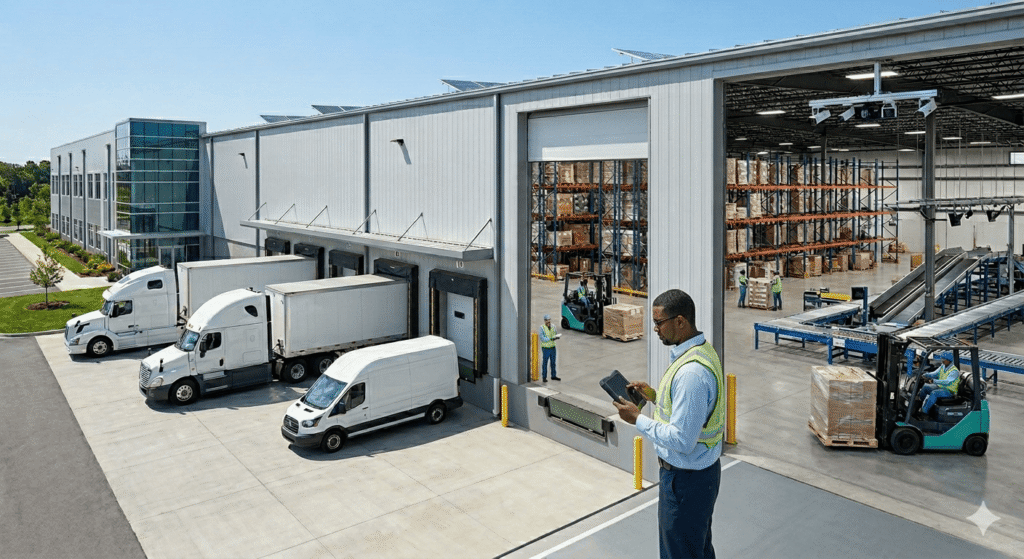
Once inventory is received from manufacturers or suppliers, goods are unloaded, inspected for damage, and verified against the corresponding purchase orders.
Effective receiving ensures that stock is logged into a Warehouse Management System (WMS) quickly, ideally within 24 to 48 hours, so it is available for sale as soon as possible.
Warehousing
After goods are received and logged, they move into the warehousing stage. This involves organizing physical inventory inside a dedicated facility so items can be stored, located, picked, and replenished efficiently.
Today, an ecommerce fulfillment warehouse is not merely a spacious facility for long-term storage. It is a dynamic environment designed for high-velocity inventory movement, where products need to stay visible, accessible, and ready for fast order processing.
SKU Storage and Slotting
Within the broader warehousing stage, inventory slotting focuses on where each SKU (Stock Keeping Unit) is placed so products can be found, picked, and replenished efficiently.
Effective slotting requires every unique SKU (Stock Keeping Unit) to have a clear, trackable location.
Strategic placement, such as keeping high-velocity “A” items closer to packing stations and slower-moving SKUs farther from primary pick paths, minimizes travel distances and helps orders move through the fulfillment process faster.
Inventory Management & Forecasting
Inventory management and forecasting involve using real-time data to monitor stock availability, track SKU movement, plan replenishment, and predict future demand.
Supply chain and fulfillment teams leverage these insights to maintain a delicate balance: having enough stock to prevent stockouts while avoiding the high carrying costs of overstocking.
Advanced AI-powered systems add another layer of control, enabling predictive replenishment that accounts for seasonal trends, shifting demand, and market volatility.
Order Processing
The moment a customer hits “buy,” order processing begins. This involves capturing order details, verifying payment, screening for fraud, and routing the order to the optimal fulfillment center based on inventory availability and customer proximity.
In modern ecommerce fulfillment systems, the entire workflow can happen in seconds, generating digital pick lists and shipping labels without manual intervention.
Picking and Packing
The picking and packing phase is where the order is shaped into a physical shipment.
Picking
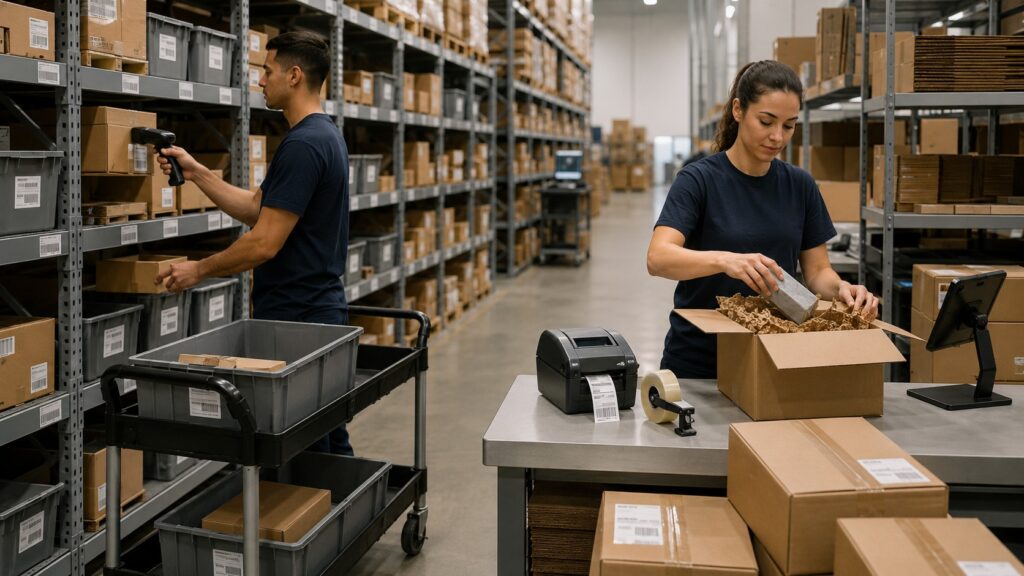
Retrieving items from shelves using different methods, like zone picking, where pickers are assigned to specific areas, or batch picking, where the same item is retrieved for multiple orders at once.
Packing
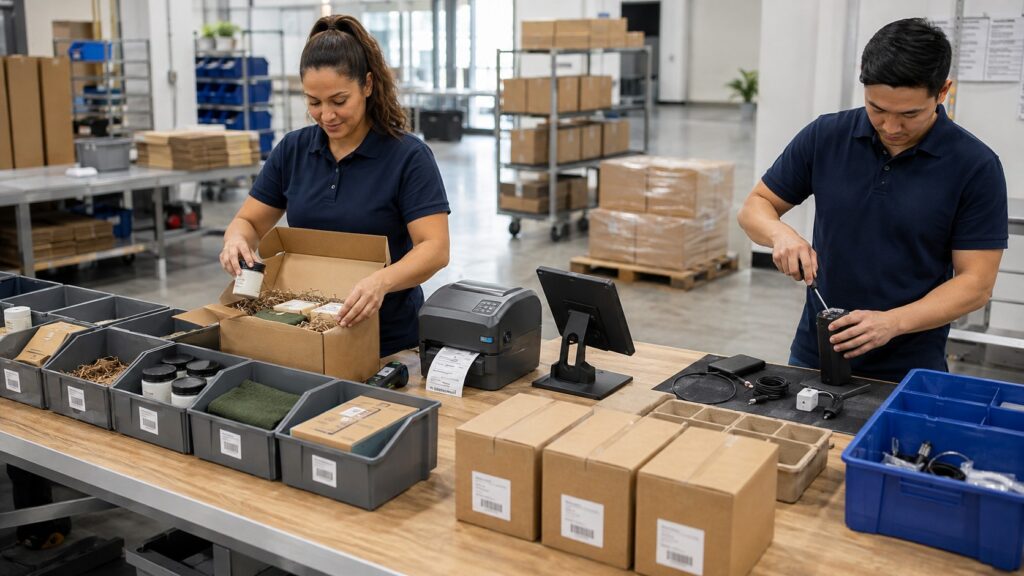
Selecting the right-sized box and protective materials to reduce dimensional weight charges and keep the product secure in transit. This stage can also serve as a branding opportunity, with custom inserts or branded labels kitted into the final package to enhance the unboxing experience.
Shipping & Delivery (The Last Mile)
The final stage involves handing packages to carriers and making sure they reach customers safely, accurately, and within the expected delivery window.
This “last mile” is the most visible part of the process for the customer because it directly shapes their perception of the brand’s reliability.
That does not always mean delivery has to be immediate.
For many shoppers, the breaking point is not the wait but the fee. According to recent statistics, 90% of U.S. consumers are willing to wait two or three days for delivery if it helps them avoid shipping costs, while 90% are also likely to abandon their carts when standard shipping fees feel too high.
Returns Management (and The Reverse Logistics Challenge)
Given the rising volume of online sales, a robust returns management strategy is essential.
To put that into perspective, it has been estimated that19.3% of online sales were returned in the last year, while 82% of consumers said free returns were important when shopping online.
The reverse logistics chain covers what happens after a product comes back. Returns management focuses on the first steps of that process, where goods are inspected, sorted, and directed to the right next step: restocking, repair and resale, recycling, liquidation, or disposal.
In the DTC (Direct-to-Consumer) context, refunds and exchanges also need to be processed quickly, so the brand can recover product value, keep inventory accurate, and maintain customer trust after the sale.
Ecommerce Fulfillment Examples
E-commerce fulfillment can solve different operational problems depending on the brand, product category, and customer promise. Here are a couple of examples of how that works in practice:
Stale Inventory Needs Faster Product Movement
For fashion and trend-driven ecommerce brands like Zara, fulfillment speed affects more than delivery. It also affects how fresh the product assortment feels to customers.
Optimized fulfillment improves product movement, inventory visibility, and coordination between demand signals and distribution. This helps brands reduce stale stock, respond faster to customer interest, and keep their customers coming back for fresh products.
Regional Delivery Performance Depends on Inventory Placement
Because ecommerce can serve customers across many locations, shoppers in different regions may receive very different delivery experiences. Often, the issue is not the carrier, but where inventory is stored.
Nike Inc.’s digital fulfillment strategy shows how regional inventory placement can help. By investing in regional service centers, the company reduced split shipments, improved outbound delivery performance, and lowered the cost of fulfilling online orders.
Ecommerce Fulfillment FAQs
What is ecommerce fulfillment?
Ecommerce fulfillment is the complete process of receiving inventory, storing products, processing online orders, picking and packing items, arranging delivery, and managing returns. It begins when inventory enters the fulfillment operation and continues until the customer receives the order or the returned product reaches its next destination.
How do you set up an ecommerce fulfillment system?
Start by creating a connected workflow for receiving, inventory storage, order processing, picking, packing, shipping, tracking, and returns. A Warehouse Management System should record each SKU’s location and stock level, while integrations with sales channels and carriers allow orders, pick lists, shipping labels, and tracking information to move through the system efficiently.
How can you improve ecommerce order fulfillment?
Improvement starts with accurate inventory data and a warehouse layout that reduces unnecessary movement. Placing fast-selling SKUs near packing stations, forecasting demand, automating order routing, selecting appropriate packaging, and positioning inventory closer to customers can shorten processing times, reduce costs, and improve delivery consistency.
How do you choose an ecommerce fulfillment provider?
Evaluate whether the provider can support your order volume, product requirements, sales channels, delivery expectations, returns process, and geographic reach. It should also offer reliable inventory visibility, suitable warehouse technology, clear service-level expectations, and the ability to scale without reducing order accuracy.
How does ecommerce fulfillment handle returns?
Returned products are received, inspected, and sorted before being directed to the appropriate next step. Depending on their condition, they may be restocked, repaired and resold, recycled, liquidated, or disposed of, while refunds or exchanges are processed and inventory records are updated.
How do you use a 3PL for ecommerce fulfillment?
The business sends its inventory to the 3PL, which receives and stores the products and connects its fulfillment systems to the relevant online stores or marketplaces. When an order is placed, the 3PL processes it, picks and packs the items, arranges shipping, provides tracking information, and can also manage returned products.
What is the difference between ecommerce fulfillment and shipping?
Shipping is one stage of ecommerce fulfillment and focuses on transferring a packed order to a carrier for delivery. Ecommerce fulfillment covers the broader operation, including inventory receiving, warehousing, order processing, picking, packing, shipping, delivery tracking, and returns.
Can ecommerce fulfillment support B2B orders?
Yes. B2B ecommerce fulfillment commonly involves larger order quantities and more detailed service requirements than consumer orders. These may include agreed delivery windows, routing instructions, labeling standards, documentation, compliance requirements, and other conditions defined through service-level agreements.
Looking for 3PL Ecommerce Fulfillment Support?
For brands outsourcing ecommerce fulfillment, ACT Fulfillment provides the U.S.-based 3PL infrastructure to receive, store, pick, pack, and ship orders with speed and accuracy.
Our model combines omni-channel integration, reverse logistics, and an employee-owned team, enabling consistent fulfillment performance without the overhead of building it in-house.
Make ecommerce fulfillment a competitive edge. Contact Act Fulfillment Today.