TL;DR
- Warehouse consolidation moves inventory and operations from several sites into fewer, larger ones, cutting duplicate safety stock, rent, and overhead.
- The savings only hold if freight and service still work, because fewer sites mean longer trips to some customers and retailer distribution centers.
- For suppliers selling into retail, the riskiest part is the move itself: every ship-from change touches vendor setups, routing, EDI, and labels.
Warehouse consolidation is the process of reducing the number of facilities in a distribution network by moving inventory, labor, and order flow into fewer sites. The goal is a smaller footprint that still meets every delivery promise.
For suppliers shipping to retailer distribution centers, the hard questions sit outside the building. Retailers expect freight from a known origin, on a booked appointment, with matching documents and labels, so a consolidation that saves on rent but breaks any of that gives the savings back in deductions.
Warehouse Consolidation vs Freight Consolidation Explained
The two terms are often mixed up. Warehouse consolidation changes the network: fewer buildings, and one inventory position where there used to be several. Freight consolidation changes the shipments: smaller loads from several suppliers or orders are combined into fuller trucks, usually at a facility called a consolidation warehouse or consolidated warehouse.
They are separate decisions, but one makes the other easier. When inventory for many retailers ships from a single site, orders that used to leave three buildings as partial loads can leave one building as full truckloads or multi-stop milk runs to retailer DCs.
Why Inventory Consolidation Lowers Safety Stock
Every site that stocks a SKU needs its own buffer against unpredictable demand, sized for its own worst week, even though those worst weeks rarely coincide. Bring the inventory into one location and swings in different regions partly offset each other, so a single stocking point needs less total buffer for the same fill rate. Planners call this inventory pooling.
Under textbook assumptions, the square root law estimates the effect: total safety stock grows with the square root of the number of stocking locations, so going from four sites to one can roughly halve it. Real networks save less when regional demand moves together, as around holiday peaks, so treat the rule as a ceiling.
Forecasting does the rest: better forecasts shrink the buffer further, and a regional forecast miss no longer strands stock in the wrong building. Keeping a single stock position for every channel extends the same logic across wholesale, store replenishment, and ecommerce orders.
Centralized Warehouse or Regional Network: The Cost Trade-Off
Consolidation trades two cost curves against each other. Fixed costs fall with every site closed: rent, management, equipment, systems, and the inventory carrying cost covered above. Economies of scale add to the gain as labor, supervision, and technology spread across more volume. Outbound freight moves the other way. Fewer sites mean longer average trips, and some customers move from one-day to two- or three-day transit.
A centralized warehouse usually wins when most volume ships as pallets or truckloads to retailer DCs on schedules set days ahead, and inbound freight arrives through one port. A regional network earns its cost when customers are spread nationally, next-day delivery is promised, or distant retailer DCs book tight appointment windows. Many large shippers settle on a hybrid: one primary site holding most inventory, plus a smaller regional site for fast movers.
For import-heavy suppliers, location matters as much as count. A primary site close to the port of entry cuts drayage and receives containers once instead of transferring them between buildings. Whether that site should be dedicated or shared space is a separate decision that follows from the volume the consolidation creates.
The Data to Pull Before You Consolidate Warehouses
A case built on rent alone overstates the saving. The numbers that decide it are operational:
- Demand by ship-to region and customer, from 12 to 24 months of order history.
- Retailer DC locations, appointment windows, and the transit times each routing guide allows.
- Order profile: how much ships as full pallets, mixed cases, or single units.
- SKU velocity, so fast movers can be slotted and moved with care.
- Outbound freight cost by lane, current and modeled.
- Peak-season curves, to confirm one building can absorb the busiest weeks.
This works best as an integrated partnership with the 3PL that will run the site: shared forecasts and order history let it test the plan against real capacity and labor, and a supply chain analysis of the current network belongs at the start of onboarding, before any lease is ended.
Keeping Retail Compliance Intact Through the Cutover
Moving inventory is the visible part. The retail setup behind each shipment holds most of the risk, because retailers grade what arrives at their docks, not why a building changed.
- Vendor setup: add the new ship-from address in each retailer’s supplier portal before the first order ships from it. Retailers that route freight themselves use it to assign carriers and pickup appointments.
- Routing: register the new origin under each routing guide and confirm carrier assignments, especially for collect freight the retailer books.
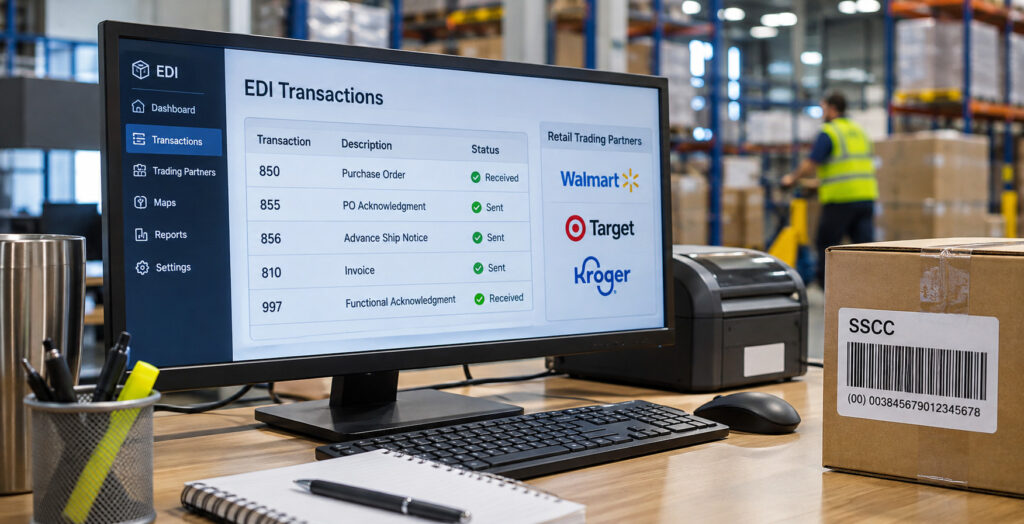
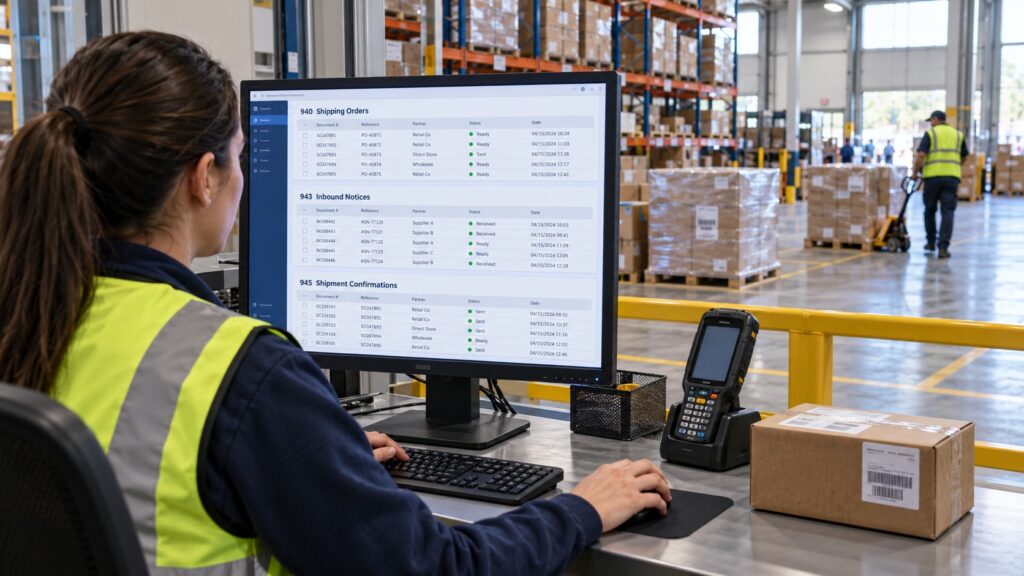
- EDI: re-map and test the 943 and 945 transaction sets between the supplier and the new site, and the 856 ASN built from them, so ship-from data matches on every document.
- Labels: print and scan-test GS1-128 carton labels from the new site’s systems before live freight moves.
Retailer EDI compliance is graded document by document, so a ship-from mismatch can fail an ASN that was otherwise correct. Reviewing deduction reason codes daily in the first weeks after cutover catches misses while they are a handful of orders, not a month of chargebacks.
Sequencing the Move: Waves, Parallel Runs, and Peak
Moving everything in one weekend puts every retail account at risk at once. A phased plan spreads it:
- Move in waves by SKU velocity: slow movers first, while the new site’s processes settle, and fast movers last, once pick paths and labor are proven.
- Count and reconcile at both ends of every transfer, so the warehouse management system at the new site starts with inventory it can trust.
- Run both sites in parallel briefly, shipping each order from wherever its stock sits, then close the old site once open orders clear.
- Keep the cutover clear of peak season and of large promotional orders already confirmed with retailers.
Active ship windows come first throughout: no wave should move stock committed to an order shipping that week. A 3PL that handles program transitions as part of its warehousing and distribution services should lay this out on a timeline before anything moves. Afterward, compare fill rate, on-time shipping, chargeback rate, and cost per order with the pre-move baseline.
Warehouse Consolidation FAQs
What is a consolidation warehouse?
A consolidation warehouse receives smaller shipments from several suppliers or orders, sorts them, and combines them into fuller loads bound for the same region, customer, or distribution center. This consolidation warehousing is a freight strategy, unlike warehouse consolidation, which reduces the number of buildings in a network. A consolidated network often delivers the same full-load benefit, because more freight leaves from one place.
Is inventory consolidation the same as warehouse consolidation?
Not quite. Inventory consolidation means bringing stock of the same items into fewer stocking locations, which can happen inside an existing network, for example by holding a slow-moving SKU in one site instead of three. Warehouse consolidation goes further and closes or exits buildings. Most warehouse consolidations include inventory consolidation, but a shipper can consolidate inventory without changing its footprint.
Does consolidating warehouses raise freight costs?
Outbound freight usually rises, because fewer sites mean longer average trips to customers and retailer distribution centers. Inbound freight often falls as containers and supplier loads go to one destination, and fuller outbound trucks offset part of the increase. Whether total cost drops depends on how much fixed cost and safety stock the move removes, so lane-level freight modeling belongs in the business case.
Do retailers need to know when a supplier changes ship-from?
Yes. Large retailers typically keep each supplier’s shipping locations in their vendor and routing setup, and the freight they route themselves is booked from that origin. A new ship-from address usually has to be added before the first purchase order ships from it, and EDI documents, especially the ASN, must carry the new location. Skipping the update can delay pickups and trigger compliance deductions.
How is a centralized warehouse different from regional DCs?
A centralized warehouse holds a product’s inventory in one location and ships every order from it, keeping safety stock and fixed costs low but lengthening transit to distant customers. Regional distribution centers place stock closer to demand, shortening delivery times at the cost of more inventory, buildings, and management. Many large shippers combine the two, with one primary site and a smaller regional one.
Planning a Warehouse Consolidation With a Retail-Ready 3PL?
ACT Fulfillment has run warehousing and distribution for suppliers selling into major retailers for more than 30 years, from warehouses in Southern California’s Inland Empire within drayage range of the Ports of Los Angeles and Long Beach. ACT keeps each building to a few large accounts, allocates wholesale, store replenishment, and direct-to-consumer orders from the same inventory, and moves programs from other providers on a planned timeline that protects active ship windows first. EDI is developed in-house, and every receipt and shipment is scanned in a tier-1 cloud WMS. Because ACT is employee-owned, the people running your account own part of the company. Talk to ACT about consolidating your network, or explore our B2B fulfillment services.