TL;DR
- Dedicated warehousing reserves a building, or a defined part of one, for a single shipper, with its own labor, equipment, and processes, usually under a multi-year agreement. Shared warehousing, also called multi-client warehousing, pools those resources across several clients in one facility.
- Company size matters less than volume stability. Steady, forecastable volume can carry the fixed cost of a dedicated warehouse, while volatile volume is usually cheaper to run in shared space that flexes with it.
- Many large shippers fit best in between: a building shared by two or three large accounts, which keeps economies of scale without the competing peaks of a 40-client warehouse.
Dedicated warehousing is a third-party logistics (3PL) arrangement in which a warehouse, or a clearly defined part of one, is operated for a single client with its own team, equipment, systems, and processes. Shared warehousing places several clients in one facility, where space, labor, equipment, and technology are pooled and costs are spread across all of them.
For a large shipper, the real question is who carries fixed cost and who absorbs volatility. A dedicated operation offers control but puts the full cost of the building on one account. A shared one turns much of that cost variable, but every client competes for the same dock doors and labor at peak.
How Dedicated and Shared Warehousing Models Really Differ
In a dedicated warehouse, the building is leased or owned by either the shipper or the 3PL, and the labor, warehouse management system (WMS), racking, and material handling equipment are assigned to one client. Agreements commonly run three to seven years, with the building lease often aligned to the service agreement.
In shared warehousing, the 3PL provides the building, racking, technology, and equipment, and clients draw on a common labor pool. Terms are typically shorter, often one to three years, and pricing tends to be transactional, charged per pallet stored, carton handled, or order shipped.
Two related terms cause confusion. Dedicated warehousing is often called contract warehousing, but contract warehousing is broader: a multi-year agreement can cover shared space as well. Dedicated warehousing sits at the dedicated end of contract logistics. At the other extreme, public warehousing is the most transactional form of shared space, with storage and handling billed as used and little long-term commitment.
Cost Structures: Fixed Overhead vs Shared Economies of Scale
A dedicated warehouse carries its rent, management, equipment, and systems whether volume is high or low. Pricing is usually cost-plus, a fixed fee plus variable handling charges, or a hybrid of the two. At high, steady utilization, that structure can deliver a lower cost per unit than transactional rates.
Shared warehousing earns its savings through economies of scale. Labor can move between accounts as volume shifts, and the cost of the building, equipment, and technology is spread across every client, so more of the shipper’s cost moves with activity.
Each model also has a hidden cost:
- Dedicated: unused capacity. A building sized for peak sits partly empty for much of the year, and that space is paid for either way.
- Shared: contention. When many clients share the same seasonal calendar, they all need doors, labor, and outbound capacity in the same weeks, and smaller accounts can slip in the queue.
Labor is usually the largest line in either model, so how labor is assigned, trained, and flexed matters more to the final cost than the rate card does.
Why Forecast Accuracy Should Drive the Warehousing Decision
A dedicated warehouse is a bet on a forecast. The building, racking, and core team are sized to expected volume for the length of the agreement. When volume runs below the forecast, the shipper pays for idle capacity. When it runs above, overflow has to go somewhere else, often at premium rates.
Shared space absorbs forecast error. That makes forecast quality, not company size, the most useful test. Before choosing a model, look at two to three years of weekly units, cartons, and pallets, then compare:
- Peak to average volume. A wide gap favors flexibility, a narrow one favors dedicated capacity.
- Forecast to actual. If last year’s plan landed close to reality, a dedicated commitment is far less risky.
- Inbound visibility. Purchase orders, container schedules, and advance ship notices tell the warehouse what is coming before it arrives.
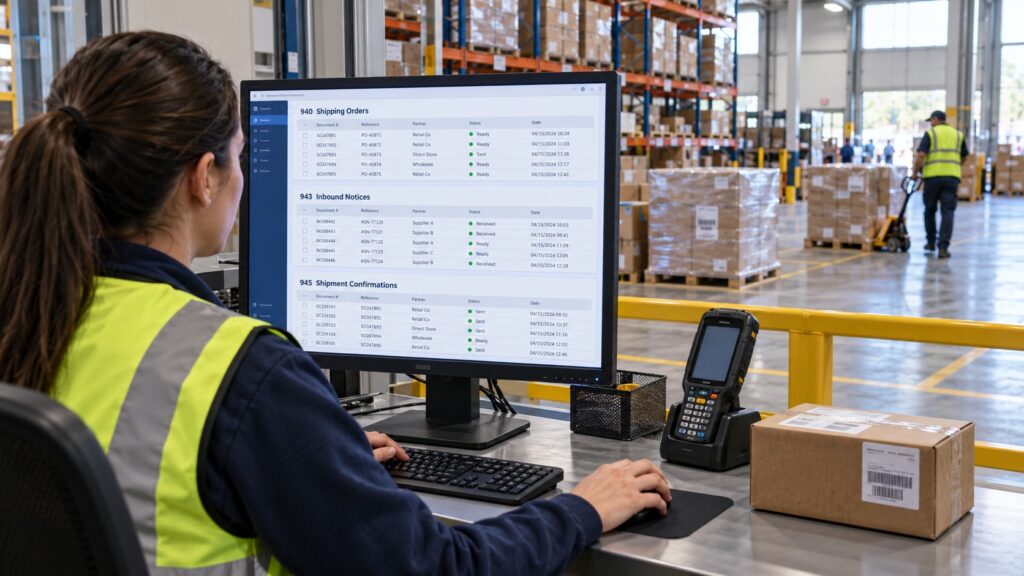
When order and receiving data flow through EDI, such as the 943 a supplier sends before inbound freight arrives, the 3PL can plan labor and dock time days ahead instead of reacting on arrival, which narrows the gap between forecast and actual in either model.
Network Consolidation and Multi-Location Distribution
Many large shippers accumulated their network rather than designed it: a regional warehouse for one retailer, an overflow site kept after a peak, a second 3PL for a new channel. Each node carries its own safety stock, fixed costs, and reporting.
Consolidating into fewer, larger nodes cuts duplicated inventory and builds enough volume in one place to justify dedicated space or a meaningful share of a building. For suppliers selling into major retailers, a consolidated node near the port of entry can receive imports once, then ship multi-SKU orders to several retailer distribution centers on their delivery schedules.
Consolidation has a trade-off: fewer nodes can mean longer transit to some customers. That is why a supply chain analysis of the current network, including where demand sits and how orders ship, should come before the choice between dedicated and shared space. The same applies when scaling from regional to national distribution.
The Few-Tenant Model: A Middle Path for Large Shippers
Most comparisons treat the decision as binary, but large shippers often fit best in a third arrangement: a building shared by two or three large accounts rather than dozens of small ones.
Each account gets defined space and a core team that knows its SKUs, routing guides, and retailer requirements. Building-level resources, including management, maintenance, technology, and flex labor, are still shared, so the economies of scale remain. Compared with a 40-client warehouse, there are fewer competing peaks; compared with a fully dedicated building, the fixed commitment is lower.
The model works best as an integrated partnership rather than a vendor arrangement. That means sharing forecasts, planning capacity jointly ahead of peak, connecting systems through EDI or API integrations, and reviewing performance against agreed KPIs, so the 3PL plans with the shipper instead of reacting to it.
Signs Your Operation Has Outgrown a Shared Warehouse
A shared warehouse that worked well at one stage can start to cost more than it saves. Common signs include:
- Steady volume billed at transactional rates. You pay per-unit pricing every month for work that is predictable.
- Service slips at peak. Dock appointments and labor are shared with clients on the same seasonal calendar.
- Compliance needs outgrow standard processes. Retailer labeling, cartonization, or value-added work requires dedicated stations and trained people.
- Limited control over systems and reporting. You need WMS configuration, KPIs, or integrations the provider will not customize for one client.
- A scattered network. Several regional shared sites have become harder to manage than one consolidated operation.
The opposite signs matter just as much. Wide volume swings, an unreliable forecast, or no appetite for a multi-year commitment point toward staying in shared space, or toward a few-tenant building, rather than taking on a fully dedicated warehouse.
Choosing a Dedicated 3PL or Shared Partner: Key Questions
Whichever model you lean toward, ask the provider:
- How many clients share the building, and how large are they?
- Is labor assigned as a core team on your account, a shared pool, or both?
- Is pricing cost-plus, fixed-plus-variable, or transactional, and what happens to cost if volume drops?
- How are dock appointments and labor prioritized when several clients peak at once?
- Can the WMS and EDI connect to your ERP and your retailer partners, and what reporting comes standard?
- How long is the agreement, and what are the exit terms?
For a broader checklist, see how to choose a 3PL.
Dedicated and Shared Warehousing FAQs
Is dedicated warehousing the same as contract warehousing?
Not exactly. Dedicated warehousing is a type of contract warehousing. Contract warehousing describes any warehousing arrangement governed by a multi-year agreement with a 3PL, which can cover dedicated space or shared space. Dedicated warehousing specifically means the facility, or a defined part of it, along with its labor, equipment, and processes, is reserved for one client. Many providers use the two terms interchangeably, so it is worth confirming exactly what is reserved for you before signing.
How long are dedicated warehousing contracts?
Dedicated warehousing agreements commonly run three to seven years, compared with about one to three years for many shared arrangements. The longer term reflects the setup involved: the building lease is often aligned to the service agreement, and racking, automation, systems integration, and staffing are built around one client. Shorter dedicated terms are possible, but the fixed setup costs are then spread over fewer years, which usually raises the monthly cost.
Is shared warehousing cheaper than dedicated warehousing?
Usually at low or volatile volume, but not always at scale. Shared warehousing spreads building, equipment, and technology costs across several clients, and most charges move with activity, so it costs less when volume is modest or swings widely. A dedicated warehouse carries fixed costs whether it is busy or not, but at high, steady utilization it can deliver a lower cost per unit. The deciding factors are volume stability and how well that volume can be forecast.
When should a company move from shared to dedicated warehousing?
The move makes sense when volume is high and steady enough to keep a dedicated operation well utilized for the length of a multi-year agreement. Other triggers include service problems at peak, compliance or handling needs that require dedicated processes, and the need for custom systems, reporting, or security. If volume still swings widely or the forecast is unreliable, a building shared with a small number of large accounts can be a better intermediate step.
What is the difference between shared and public warehousing?
Both place several clients in one facility, but they differ in commitment and service depth. Public warehousing is the most transactional form: businesses rent space and handling as needed, often with little or no long-term commitment, and pay for what they use. Shared warehousing under a 3PL agreement usually involves a defined term, integrated systems, agreed service levels, and value-added work such as labeling and kitting, alongside storage and fulfillment.
Looking for a Warehousing Partner Built for Large Shippers?
Large, long-term programs are where ACT Fulfillment does its best work. For more than 30 years, ACT has run warehousing and distribution for suppliers selling into major retailers, from warehouses in Southern California’s Inland Empire within drayage range of the Ports of Los Angeles and Long Beach. ACT builds its operations around a few large accounts per building rather than dozens, and where a brand already controls its own facility, ACT can supply the managers, pickers, and packers to run it. In-house EDI, a cloud-based, RF-driven WMS, and scheduled reporting give your planners real data to forecast against. Because ACT is employee-owned, the people running your account own part of the company. Talk to ACT about your warehousing program, or explore our 3PL services.