TL;DR
- Retailer chargebacks are deductions a retailer takes from a supplier’s payment when a shipment breaks its routing guide, labeling, EDI, or delivery rules.
- Most trace back to a few repeatable failures, such as late or short shipments, ASN mismatches, and labeling or packaging errors, and many start well before the truck leaves.
- Large suppliers cut them by building each retailer’s rules into the warehouse floor, fixing forecast and network problems upstream, and disputing invalid deductions with solid evidence.
Retailer chargebacks, also called vendor chargebacks, are penalties a retailer deducts from what it owes a supplier when a shipment fails to meet the terms in its vendor manual or routing guide. They are not the same as credit card chargebacks, which are consumer payment disputes.
For a supplier shipping into several retailers, chargebacks are a running report on execution quality. Each one points to a specific failure in the order, warehouse, or transportation flow, and the suppliers who keep them low treat them as operational data, not an accounting nuisance.
How Retailer Chargebacks Work, From Deduction to Dispute
Every major retailer publishes its requirements in a vendor manual or routing guide, covering purchase orders, labels, packaging, EDI documents, carriers, and delivery appointments. When the retailer’s receiving team or audit systems flag a violation, the penalty is not invoiced. It is deducted from a later payment and shows up on the remittance, often weeks after the freight was delivered.
Penalties take two broad forms: a flat fee per violation, carton, or shipment, or a percentage of the invoice or of the cost of goods on the non-compliant part of an order. Because deductions arrive late with terse reason codes, they often land in accounts receivable, far from the logistics team that could fix the cause, which is why the same chargeback can repeat for months.
The Most Common Causes of Retail Chargebacks for Suppliers
Retailers word their rules differently, but most retail chargebacks fall into a handful of categories:
- Timing. Freight arrives outside the delivery window or must-arrive-by date, misses its appointment, or ships too early. Many retailers measure this through on-time, in-full (OTIF) programs.
- Quantity. Short shipments, overages, or unauthorized substitutions against the purchase order.
- ASN and EDI errors. A late, missing, or inaccurate advance ship notice, or invoice data that does not match the order.
- Labeling. Missing, unscannable, or misplaced carton and pallet labels, typically GS1-128 shipping labels, or wrong price tickets on the product.
- Packaging and pallets. The wrong case pack, mixed SKUs on a pallet where the guide prohibits them, overhang, or damaged pallets.
- Routing. A carrier or shipping mode the routing guide does not allow.
Many of these start before the outbound dock. Our container devanning guide covers how receiving errors turn into short shipments and ASN mismatches, and our overview of retail fulfillment shows where chargebacks fit in the wider process.
Why ASN and EDI Errors Drive So Many Vendor Chargebacks
Retailer distribution centers plan receiving around the 856 advance ship notice. It tells them which cartons are on the truck and what is in each one. When a carton label does not match its ASN record, or the ASN arrives after the freight, the DC has to stop and reconcile by hand, and the retailer passes that cost back as a chargeback, even when the goods themselves are right.
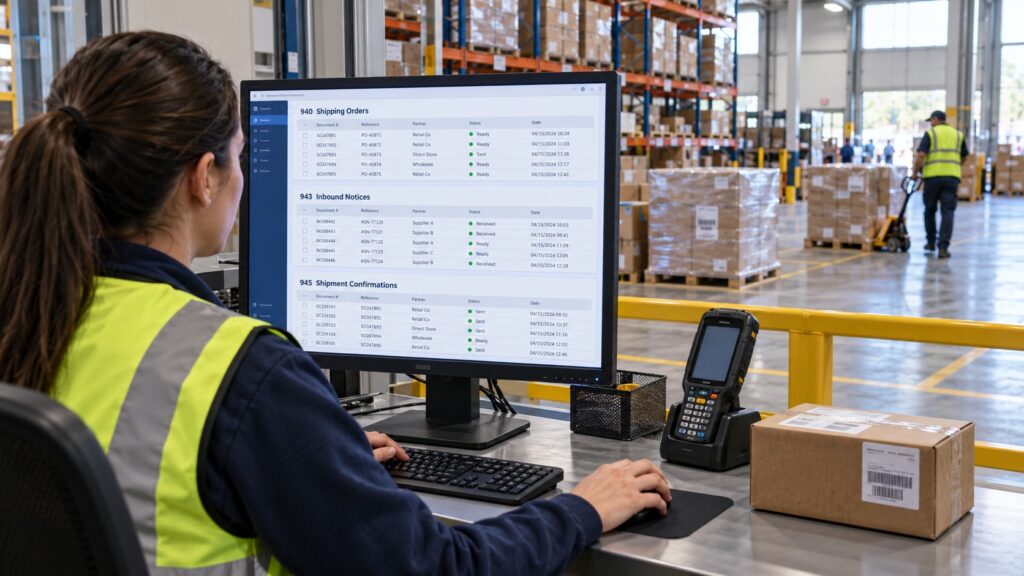
The ASN is only as accurate as the warehouse data behind it. In a typical 3PL flow, the supplier sends a 943 so the warehouse can prepare to receive, and the warehouse returns a 945 confirming what actually shipped, which feeds the 856 the retailer sees. If cartons are packed from one record and the 945 is built from another, the ASN drifts from the freight. Scan-based packing, with EDI run by the team that runs the floor, matters more than the EDI software itself. ACT handles its EDI in-house so chargeback prevention stays with the people shipping the freight.
Forecasting and Network Design: Fixing Chargebacks Upstream
Some of the costliest chargebacks are not warehouse mistakes at all. A short shipment often starts with a forecast that left too little stock in the right place, and a late delivery with inventory sitting in the wrong building.
- Forecasting. Sharing retailer order forecasts and inbound container schedules with the warehouse lets labor and dock time be planned before large purchase orders drop, instead of after.
- Network consolidation. Serving several retailers from scattered sites multiplies routing guides, label setups, and handoffs. Fewer nodes put inventory in one pool and each retailer’s rules in one playbook, and a supply chain analysis shows where consolidating cuts error points without adding transit time.
- Integrated partnerships. Chargeback data should flow from accounts receivable back to the warehouse. When the 3PL sees deduction reports and reason codes, it can trace each one to a process and fix it, rather than hearing about the problem months later.
How Large Suppliers Prevent Retailer Chargebacks at Scale
At volume, prevention has to be built into the process rather than left to memory:
- Assign ownership. Chargebacks touch logistics, sales, and finance, and often nobody owns them. Name one owner and review deductions monthly by retailer and reason code.
- Turn routing guides into floor rules. Each retailer’s label, carton, and pallet requirements should be configured in the system and enforced by scans at the pack station, so B2B fulfillment works to the guide each account is held to.
- Track guide changes. Retailers revise routing guides and label standards, and someone has to catch each change before the next shipment.
- Audit before the truck leaves. Check labels, carton counts, and pallet builds against the ASN at the dock. Relabeling and re-ticketing fix noncompliant cartons before they ship, and quality holds keep suspect inventory off the truck.
- Use economies of scale. A 3PL running many retail programs builds compliance knowledge across all of them, and a building shared by a few large accounts gives each one a core team that knows its retailers’ rules, as covered in dedicated vs shared warehousing.
Disputing Retail Chargebacks With Evidence That Holds Up
Not every deduction is valid. Retailers make mistakes too, but the burden of proof sits with the supplier, usually within a dispute window each retailer sets. Strong disputes rest on records captured at the time of shipment:
- Time-stamped EDI transmission and acknowledgment records, to prove the ASN went out on time.
- Signed bills of lading and proof of delivery, to prove what was tendered and received.
- Carrier check-in and appointment records, to show when the truck actually arrived.
- Photos of pallets, labels, and loaded trailers, to show the shipment left compliant.
Disputing only recovers money once. Pair every valid chargeback with a root-cause fix and track repeat rates by retailer, so the queue shrinks over time.
Retailer Chargebacks FAQs
What is the difference between a chargeback and a deduction?
Deduction is the broader term. It covers any amount a retailer subtracts from a supplier’s payment, including promotional allowances, pricing disputes, shortages, and damage claims. A chargeback is a deduction tied to a compliance failure, such as a late delivery, a labeling error, or a missing advance ship notice. Retailers and suppliers often use the terms interchangeably, so read each deduction’s reason code to see which kind it is and whether it can be disputed.
Are retailer chargebacks the same as credit card chargebacks?
No. A credit card chargeback is a payment dispute a consumer files through their card issuer, which reverses a transaction and can cost the merchant a fee. A retailer chargeback is a penalty a retailer deducts from a supplier’s payment when a wholesale shipment breaks its compliance rules. The first is a consumer protection mechanism in payments. The second is a contract term between a retailer and its vendors, enforced through the vendor manual and routing guide.
How much do retailer chargebacks cost suppliers?
It varies by retailer and by violation. Some penalties are flat fees per violation, carton, or shipment, while others are a percentage of the invoice or of the cost of goods that missed the requirement. Individually they can look small, but across many purchase orders and several retailers they add up to a meaningful share of retail revenue. The most reliable way to size the problem is to total a year of deductions by retailer and reason code.
How long do suppliers have to dispute a chargeback?
Each retailer sets its own dispute window and process, usually managed through its vendor portal, so check the vendor manual for every account. The clock typically starts from the deduction, not the shipment, and some windows are short. Because deductions can appear well after the freight has delivered, suppliers who review remittances regularly and keep shipping records easy to retrieve have a much better chance of filing in time.
Who pays a chargeback caused by the 3PL?
It depends on the service agreement. Many 3PL contracts state which penalties the provider absorbs, such as those caused by mispicks or wrong labels, and which stay with the supplier, such as late purchase orders, missing factory inventory, or carrier delays. Settle this before signing, along with how chargeback reports are shared and how disputes are handled. Clear terms keep both sides focused on fixing root causes rather than arguing over who pays.
Looking for a Retail Partner That Keeps Chargebacks Down?
Retail is where ACT Fulfillment has built its business for more than 30 years, running case and pallet programs into major retailers’ distribution centers from warehouses in Southern California’s Inland Empire. EDI is handled in-house, with inbound 943s and outbound 945s feeding the 856 ASN your retail partners expect, in a fully RF-driven, paperless operation. Retailer-specific relabeling and re-ticketing keep cartons compliant as standards change, and BOLs, PODs, and reports are available in the customer portal when you need them. Because ACT is employee-owned, the people handling your freight own part of the company. Talk to ACT about your retail programs, or explore our B2B fulfillment services.