TL;DR
- Pick and pack is the warehouse process of retrieving the individual items in a customer’s order (picking) and preparing them in sealed, labeled packaging for shipment (packing), rather than fulfilling in bulk.
- The pick and pack process runs in four connected steps: order receipt and pick list generation, picking items from storage, packing and protecting the order, then labeling and shipping to the carrier.
- Warehouses choose among picking methods such as discrete, batch, cluster, zone, wave, and robotic goods-to-person, then apply packing strategies like cartonization, kitting, and standardized protection rules.
- Fulfillment performance depends on efficient warehouse layouts, the right picking technology, and consistent metric tracking, which together lower costs and improve order accuracy.
What Is Pick and Pack?
Pick and pack is the warehouse process of retrieving from storage the individual items a customer has ordered (picking) and preparing them in sealed, labeled packaging for shipment (packing). Unlike bulk fulfillment methods, it is designed to assemble individual, often multi-item orders according to each customer’s exact requirements.
How the Pick and Pack Fulfillment Process Works
Pick and pack fulfillment moves an order from the moment it is placed to the moment it leaves the dock, in four connected steps. Each step feeds the next, so a slowdown at any stage holds up the whole cycle.
Step 1: Order Receipt and Pick List Generation
The process begins when a customer order enters the system through an online store, a marketplace, or an EDI feed from a retail partner. A warehouse management system (WMS) or order management system records the order and generates a pick list, either printed or pushed to a handheld device, that tells the picker exactly which SKUs and quantities to collect. In a multi-site network, routing logic can also assign the order to the facility with the right stock and the shortest transit distance.
Step 2: Picking the Ordered Items from Storage
With the pick list in hand, a picker or an automated system travels to the storage locations and retrieves the exact items and quantities the order calls for. How that trip is organized depends on the method in use, from one order at a time to batched or zoned routes. The warehouse picking strategies covered below determine how these trips are grouped and sequenced for speed and accuracy.
Step 3: Packing and Protecting the Finished Order
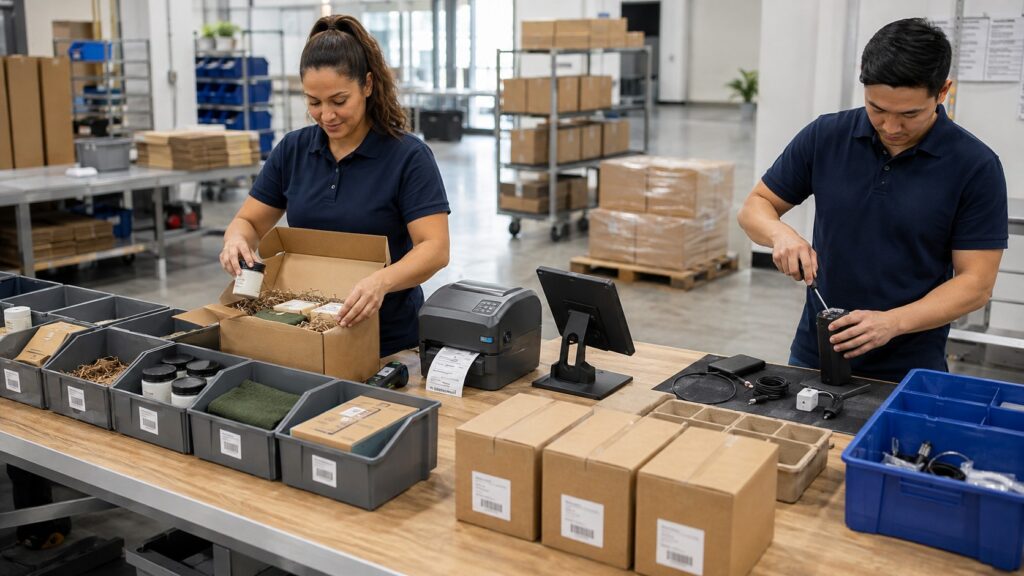
Picked items move to a packing station, where a packer confirms the contents against the order, selects a suitable box or mailer, and secures the goods with protective fill such as paper, foam, or air pillows. Fragile, oversized, or hazardous items follow specific handling rules so they arrive intact. The packing strategies section below goes deeper into cartonization, kitting, and standardized protection rules.
Step 4: Labeling, Documentation, and Shipping
Once sealed, the parcel receives a shipping label and any required paperwork, such as a packing slip or customs documents for international orders. The order is then staged by carrier and handed off for collection, and tracking details are passed back to the customer. Accurate labeling at this stage prevents misdeliveries and protects the promised delivery window.
Benefits of Efficient Pick and Pack Fulfillment
Optimized workflows in a pick and pack fulfillment center improve processing speed, accuracy, cost control, and the overall customer experience.
Faster Order Processing
Streamlined picking and packing reduces the time between order placement and carrier handoff.
Organized inventory and coordinated packing workflows allow warehouse teams to prepare orders faster and meet demanding dispatch deadlines, helping businesses meet customer expectations for prompt delivery.
Improved Order Accuracy
Structured picking and packing workflows reduce the risk of selecting the wrong SKU or quantity. Clear picking instructions and verification tools, such as barcode scanning, RFID, voice picking, or pick-to-light systems, help confirm items at key stages of the process.
In turn, greater accuracy reduces shipping errors, replacement orders, returns, and related customer service costs.
Lower Fulfillment Costs
Efficient pick and pack operations reduce unnecessary travel, handling, and labor time per order.
Strategic inventory placement and order-picking methods, such as batch or zone picking, allow warehouse teams to process more orders with fewer wasted movements – ultimately lowering the labor cost associated with each order.
Flexible Customization and Branding
Because orders are prepared individually at the packing stage, businesses can incorporate branded boxes, promotional materials, personalized inserts, and other custom elements.
Value-added services such as kitting can also combine separate products into bundles, promotional sets, or subscription boxes.
These added touches help businesses create a more branded and memorable experience from the moment the package arrives through to unboxing, while keeping customization integrated into the standard fulfillment process.
Higher Customer Satisfaction
Beyond the appeal of a personalized package, accurate picking reduces order errors so that customers receive the correct products in the right quantities, while secure packing protects products in transit and lowers the risk of damage-related complaints.
Top Pick and Pack Strategies
Pick and pack warehousing uses several methods to organize order fulfillment. The choice depends on factors such as order volume, SKU variety, warehouse layout, service requirements, and facility infrastructure.
Warehouse Picking Strategies
In the warehouse, key picking strategies determine how orders are grouped, routed, and retrieved before they move to packing.
Discrete Picking
With discrete picking, one picker retrieves all the items required for a single order before moving on to the next.
This approach is straightforward to implement and keeps orders separate and easier to manage, making it well suited to smaller businesses with lower order volumes.
Batch Picking
To reduce travel time, pickers retrieve items for multiple orders during a single pass through the facility. This method is particularly effective for operations handling high volumes of similar orders that share common SKUs.
For context, best-in-class warehouses pick and ship at least 70 order lines per labor hour, although performance depends on the picking method, order profile, layout, and level of automation.
Cluster Picking
Instead of picking one order at a time or mixing multiple orders into a single bin, a picker travels the warehouse with a multi-compartment cart.
They pick items for several distinct orders simultaneously, sorting them immediately into dedicated containers on the cart to reduce the need for post-pick sorting.
Zone Picking
The facility is divided into designated areas, and warehouse staff or automated systems retrieve only the items stored within their assigned zones. Items or order containers may move between zones or be consolidated after picking before they proceed to packing.
Wave Picking
Wave picking groups orders into batches, or “waves,” based on factors such as shipping deadlines, carrier routes, order priority, or available capacity.
During each wave, warehouse staff or robots retrieve items for multiple orders according to the planned release schedule. Depending on the warehouse design, wave picking may also be combined with zone or batch picking.
Robotic Goods-to-Person Picking
Robots or automated storage systems bring inventory containers or mobile shelving directly to stationary picking workstations. This greatly reduces picker walking and can increase throughput, although it requires significant investment in equipment, software, and system integration.
Top Packing Strategies
Packing is the final stage of pick and pack logistics where products are verified, secured, and prepared for shipment. It completes the pick, pack, and ship cycle before orders are handed off to the carrier.
Cartonization
Cartonization software recommends a suitable box or shipping container based on factors such as product dimensions, weight, fragility, and packing restrictions. This reduces material waste, unused space, and dimensional-weight charges while helping protect products during transit.
Kitting
Kitting can simplify subsequent picking and packing by assembling frequently purchased product combinations in advance as a single unit or SKU. This allows teams to retrieve a prepared kit instead of locating each component separately.
It is commonly used for subscription boxes, promotional bundles, and standardized product sets.
Standardized Protection Rules
Establishing clear packaging rules for different product types helps teams choose suitable containers, protective fill, and sealing methods consistently.
Materials such as paper, foam, bubble wrap, or air pillows can be assigned according to product size, weight, fragility, and shipping requirements, reducing guesswork and speeding up packing.
Order Picking Best Practices
Within a pick and pack warehouse, strong order-picking practices improve speed, accuracy, safety, and consistency.
Optimize Your Warehouse Layout
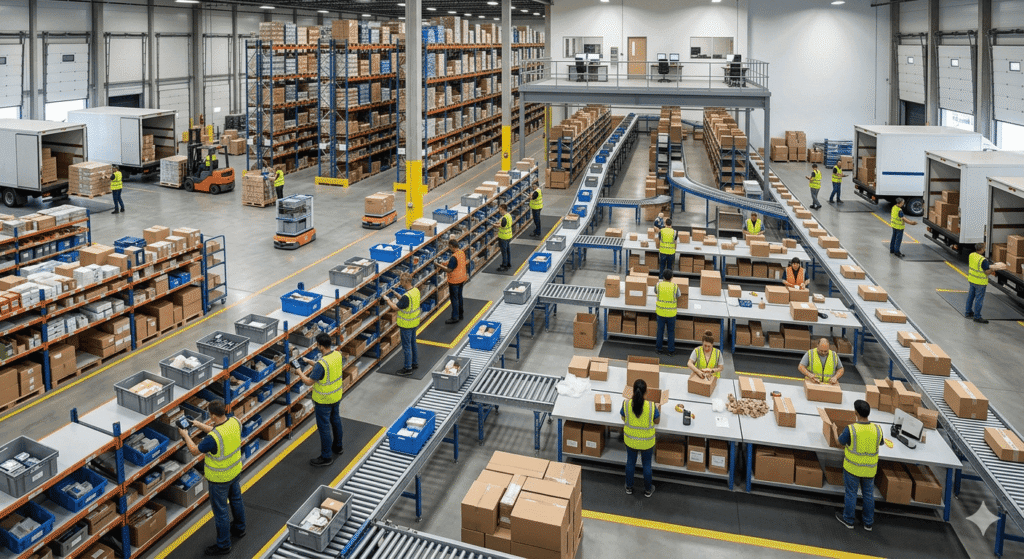
Create a logical flow from receiving and storage through picking, packing, and shipping. Position high-velocity SKUs in accessible picking locations, minimize unnecessary travel, and avoid layouts that create congestion around popular products or work areas.
Set Realistic Picking Targets
Productivity targets should encourage efficiency without compromising worker well-being.
A recent study in traditional retail scenarios found that increasing the allowed picking time by just 1% reduced average picker fatigue by approximately 10%. The findings indicate that overly strict time targets can harm both worker well-being and picking efficiency.
Integrate the Right Technology
Select technology according to your order volume, SKU profile, warehouse layout, and verification needs.
Tools such as barcode scanners, RFID, voice picking, pick-to-light systems, and mobile devices can guide workers, confirm items and quantities, record inventory movements, and identify errors before orders reach shipping.
Track the Right Performance Metrics
Monitor picking accuracy, productivity, processing time, and readiness for carrier collection to identify bottlenecks and measure whether operational changes are working.
Compare results over time and against relevant industry benchmarks, while accounting for differences in order profiles, facility layouts, and automation levels.
Should You Outsource Pick and Pack to a 3PL?
Outsourcing allows growing brands to scale without investing in additional fulfillment infrastructure. With more than 30 years of experience, ACT Fulfillment provides dependable 3PL logistics tailored to your operational needs. Contact us today.
Pick and Pack FAQs
When should you outsource pick and pack to a 3PL?
Outsourcing usually makes sense once order volume outgrows the space, labor, or software you can manage in-house, or when seasonal spikes force you to staff for a peak you only hit a few months a year. Other common triggers include expanding into new sales channels or regions, running out of warehouse capacity, or spending more hours on fulfillment than on your actual product. A third-party logistics provider absorbs the picking, packing, and shipping so a growing brand can scale without buying more infrastructure.
How much does pick and pack fulfillment cost?
Pick and pack pricing is rarely a single flat rate. Most providers build a quote from a few components: a pick fee charged per item or per order, packaging materials, monthly storage based on the space your inventory occupies, and carrier shipping costs. The order profile matters too, since multi-item orders, kitting, and special handling for fragile or oversized goods add labor. Because these variables differ by business, most 3PLs price each account individually rather than publishing fixed rates, so the most reliable figure comes from a quote based on your real SKUs and volume.
What is a pick and pack warehouse?
A pick and pack warehouse is a fulfillment facility set up to assemble individual customer orders rather than move goods in bulk pallets. Its layout, storage systems, and staffing are organized around retrieving specific SKUs, packing them into shipment-ready parcels, and handing them to carriers quickly and accurately. These warehouses typically run a warehouse management system to direct picking routes and verify orders, and many are operated by third-party logistics providers that fulfill for several brands under one roof.
What is Amazon pick and pack?
Amazon pick and pack refers to the picking and packing Amazon performs on a seller’s behalf through Fulfillment by Amazon (FBA). Sellers send inventory to Amazon’s fulfillment centers, and Amazon stores the items, then picks, packs, and ships them when an order comes in, charging per-unit fulfillment fees plus storage. It is one option among several. Sellers can also handle fulfillment themselves or use an independent third-party logistics provider, which often gives more control over branding, packaging, and multi-channel orders that reach beyond the Amazon marketplace.
What is the difference between pick and pack and kitting?
Pick and pack retrieves and packages the specific items on each incoming order, one order at a time. Kitting happens earlier: frequently combined products are assembled into a single ready-to-ship unit or SKU in advance, so the picker grabs one prepared kit instead of gathering each component separately. In practice the two work together. Kitting prepares bundles like subscription boxes or promotional sets ahead of demand, which then speeds up the picking and packing of the orders that contain them.
How is pick and pack different from bulk fulfillment?
Pick and pack builds individual customer orders, selecting the exact items and quantities each order needs and packing them for direct shipment. Bulk fulfillment moves large, uniform quantities of a single product, such as full pallets or cases sent to a retailer or distribution center. The difference is granularity: pick and pack handles many small, varied, often multi-item shipments to end customers, while bulk fulfillment handles fewer, larger, standardized loads. Most ecommerce and direct-to-consumer operations rely on pick and pack because their orders are small and highly individualized.